

ChatGPT Finally Stopped Gaslighting You
GPT-5.2 is here, and it actually follows instructions


You tell ChatGPT: keep it under 200 words.
It gives you 350. You point this out. It apologizes so sincerely. Then gives you 340. You remind it again. It says “You’re absolutely right, I’ll fix that!” and gives you 320 with a few bonus suggestions you didn’t ask for.
You’re not being unclear. The model just doesn’t listen. It agrees with you, validates you, apologizes… and then does whatever it was going to do anyway.
This has been the core frustration with ChatGPT for anyone who uses it seriously. The model is smart enough to be genuinely useful. But you can’t trust it to stay on task. You can’t hand it instructions and walk away. Every output needs scrutiny, every fact needs checking, every “got it, I’ll do that!” needs verification because half the time it didn’t actually do that.
If ChatGPT were a coworker, HR would be involved by now.
GPT-5.2 dropped on December 11th, and OpenAI focused on exactly this problem. Now ChatGPT admits when it’s guessing instead of making things up. It follows your formatting and tone instructions through the whole conversation instead of abandoning them two responses into the convo. It stops when the task is done instead of adding extras you didn’t request.
For anyone who’s built their workflow around ChatGPT, or tried to and given up because of the inconsistency: this is the update worth paying attention to.
The Drop
Here’s the quick version:
5.2 admits when it’s guessing. Add “if you’re unsure, say so” to your prompts. 5.2 actually respects this now.
Your instructions stick. Your formatting and tone rules persist through the whole conversation, not just the first three responses.
Your AI assistant stops when the task is done. No more bonus suggestions, follow-up questions, or unsolicited advice you didn’t ask for.
Knowledge cutoff update: August 2025. Big jump from 5.1’s September 2024. Use web search still for anything recent.
The Problem This Solves
Let’s be honest about what’s been broken.
You ask for three bullet points, you get a dissertation. You set up a system prompt with specific formatting, and by response four, the model is freelancing. You tell it not to add suggestions, and it adds suggestions anyway—politely, enthusiastically, like a golden retriever who heard “no” but is pretty sure you meant “yes.”
This was never a capability problem. ChatGPT has been smart enough to be useful for two years. The problem was trust. You couldn’t hand off a task and walk away. You had to babysit every output, which defeats the entire point of having an assistant.
And if you’re building automations? Forget it. One hallucinated field, one random format change, one “helpful” addition the model decided to throw in—your whole workflow breaks. That’s not a minor inconvenience. That’s technical debt with a personality disorder.
GPT-5.2 is OpenAI’s attempt to fix this. Not by making the model smarter, but by making it listen.
What Changed
I read through OpenAI’s prompting guide for 5.2, and the language tells you exactly where they focused. Three things jumped out.
It admits when it’s guessing
5.2 prefers being correct over sounding confident. When it doesn’t know something, it’s more likely to say so instead of making something up and hoping you don’t check.
So now you can add instructions to your prompts like:
“If you’re unsure about something, say so instead of guessing. Use language like ‘Based on the provided context...’ rather than absolute claims.”
With previous models? That was a suggestion the AI would ignore when convenient. With 5.2? Instructions actually hold.
This alone levels up ChatGPT anyone doing research, client work, or anything where a hallucinated “fact” causes real problems downstream.
Instructions stick for the whole conversation
The instructions you set at the start of a conversation don’t get forgotten halfway through.
If you’ve used ChatGPT for long conversations, you know the drift. You set formatting rules, tone requirements, “do not add suggestions I didn’t ask for” and the model follows them beautifully for about three responses. Then it starts freelancing again, and by response ten it’s completely forgotten what you asked for.
5.2 holds the line better. Your formatting requests, your tone requirements, your “do not add unsolicited suggestions” rules - they persist.
It stops when the task is complete
No more unsolicited extras. The response ends where your assignment ends. You ask for a summary, you get a summary. Not a summary plus five follow-up questions or “here are some other things you might want to consider.”
If you’ve been padding every prompt with “do not include additional suggestions,” test dropping it. 5.2 respects scope better by default.
Knowledge cutoff jumped
GPT-5.2 has a knowledge cutoff of August 31, 2025 across all three modes. This is a significant jump from GPT-5.1’s September 2024 cutoff.
If you’re prompting about recent news, product launches, or anything that changed in the last few months, either use web search or prompt explicitly: “Your knowledge may be outdated on this topic. If you’re unsure about current details, say so.”
How to Prompt GPT-5.2
Here’s where most coverage of this update stops. “Cool features, go try it!” Useless.
Let me tell you what I’m actually changing in my workflows.
Simplify your guardrail prompts
You know those elaborate system prompts we’ve all built? The ones with seventeen rules because the model kept breaking the first sixteen?
Try cutting them down. 5.2 is better at inferring reasonable constraints, so some of that defensive prompting might be unnecessary now.
Start lean, add rules back only when the model actually breaks them.
Add the uncertainty instruction to everything
I’m adding this to every custom GPT and automation prompt I maintain:
If you lack sufficient information to answer accurately, say so explicitly. Do not fabricate details, statistics, or sources. When uncertain, state your confidence level.
This used to be wishful thinking. Now it’s an actual constraint.
Be explicit about length
5.2 responds better to explicit length and depth instructions. Be specific:
“Answer in 2-3 sentences maximum.”
“Provide a comprehensive analysis. Length is not a concern.”
“Brief response. No preamble, no summary, just the answer.”
The model actually respects these now, instead of treating them as loose suggestions.
Match the mode to the task
GPT-5.2 comes in three versions:
Instant: Fast, everyday tasks. Email drafts, quick questions, simple rewrites. This is your daily driver.
Thinking: Complex work that benefits from reasoning. Code review, multi-step analysis, document processing, anything where you want the model to slow down and think.
Pro: High-stakes accuracy. Financial analysis, legal review, anything where being wrong is expensive.
Stop using Thinking mode for everything. It’s slower and costs more tokens. Use Instant for quick tasks, escalate to Thinking when you actually need depth.
Spreadsheets Never Looked So Good
Here’s the same prompt given to GPT-5.1 Thinking and GPT-5.2 Thinking:
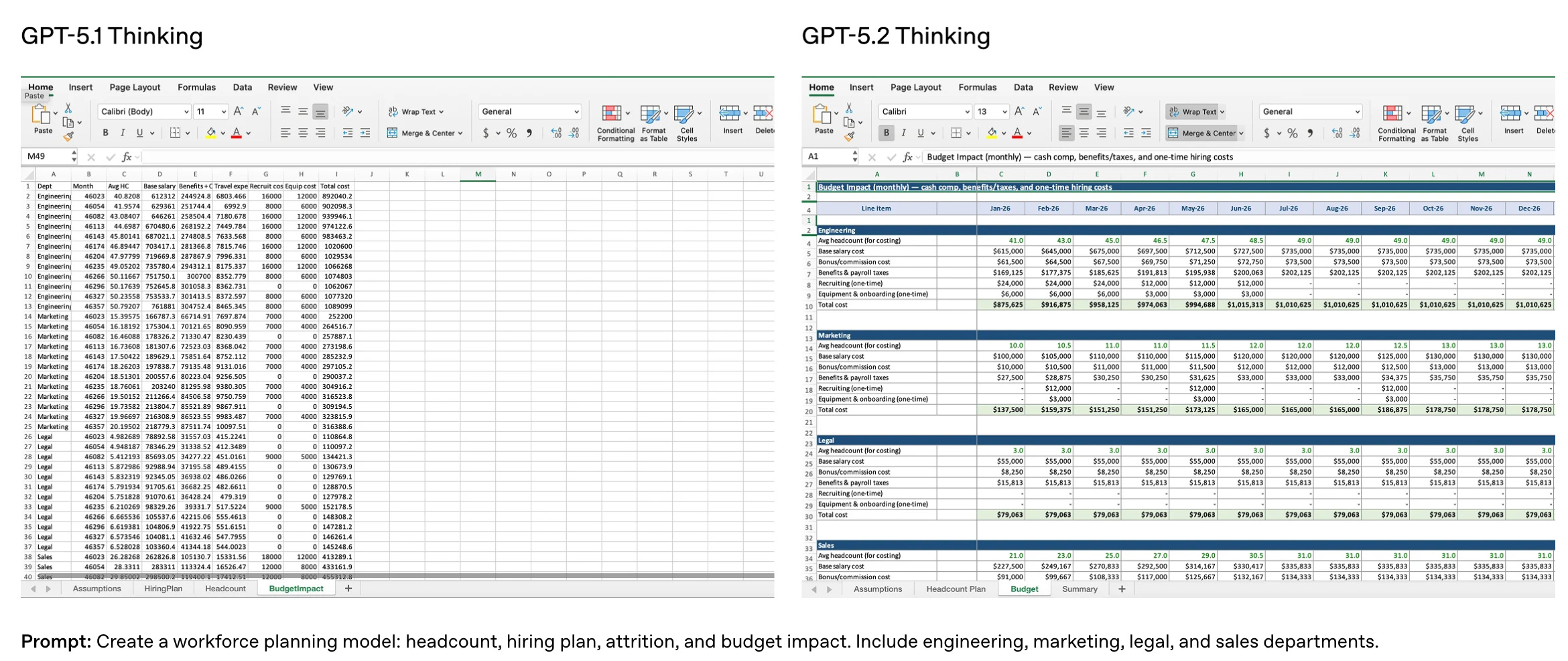
“Create a workforce planning model: headcount, hiring plan, attrition, and budget impact. Include engineering, marketing, legal, and sales departments.”5.1 gives you a data dump. 5.2 gives you a deliverable. Organized by department, formatted for readability, structured like something you could hand to your CFO without apologizing first.
Same prompt. Same model tier. The difference is whether the model understood “create a workforce planning model” as “generate some related data” or “build me something I can use.”
I posted this comparison on Threads this week. Excel’s official account replied.
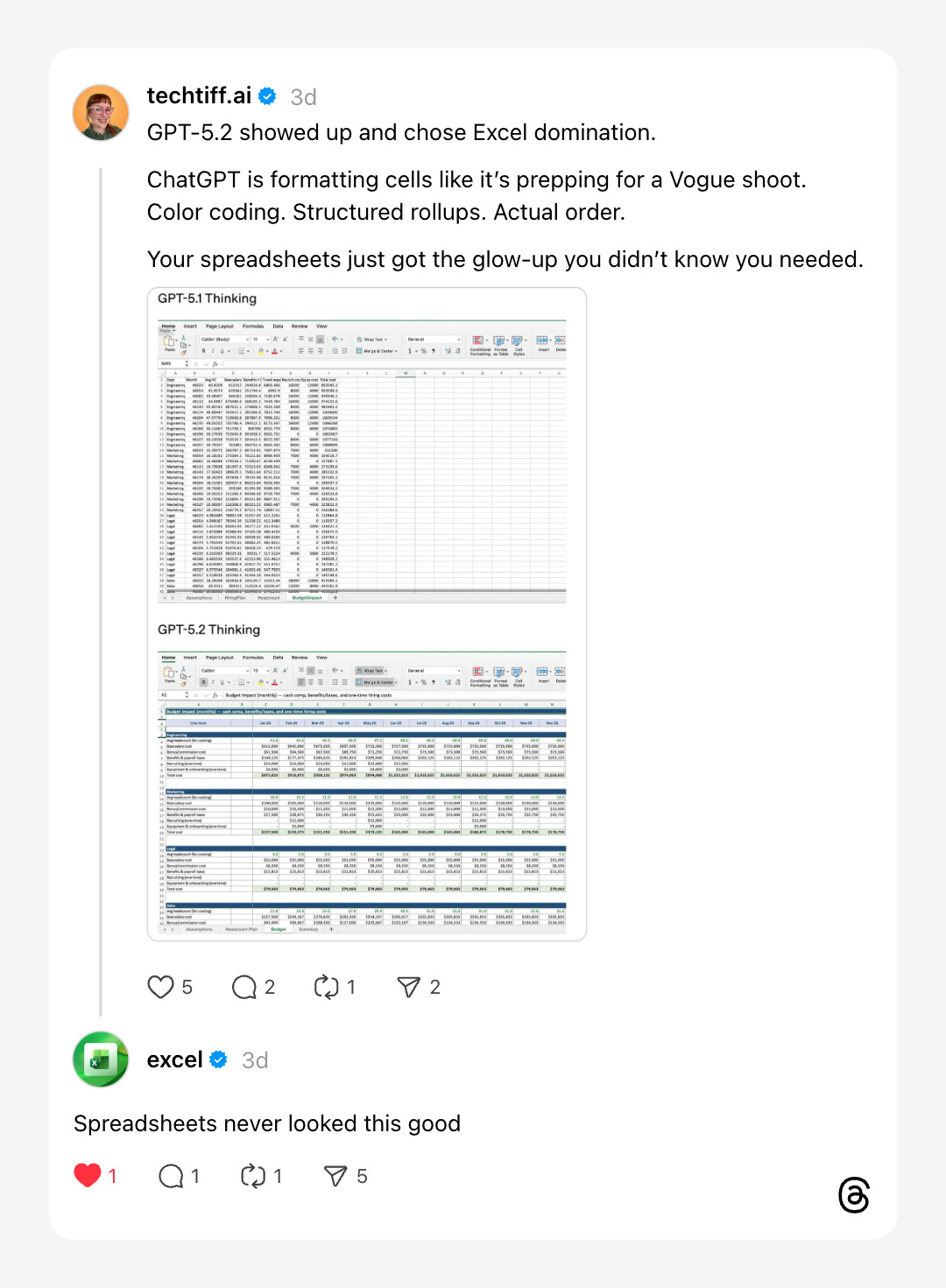
This is what “better instruction adherence” looks like when it hits your actual workflow.
The Bottom Line
GPT-5.2 isn’t a massive leap in what the model can do. It’s a meaningful leap in whether you can trust it to do what you asked.
Smart AI is impressive. Reliable AI is useful.
OpenAI clearly heard the feedback: we don’t need more capabilities. We need the existing capabilities to work consistently, without constant supervision, without random creative additions, without confident hallucinations.
That’s what 5.2 delivers. Not just a smarter assistant, but a more dependable one.
For anyone building real workflows with ChatGPT, that’s the upgrade that actually matters.

Thank you for sharing this wonderful useful information :)
Thank you for your review!!